 Streamline
 India’s democratic framework rests heavily on the credibility and independence of its constitutional institutions. Among these, the Election Commission of India (ECI) occupies a central position, entrusted with conducting free and fair elections across the world’s largest democracy. In a significant development, the Supreme Court recently declined the Centre’s request to defer hearings on petitions challenging the 2023 law governing the appointment of election commissioners.
The case has drawn national attention because it directly concerns the process through which India’s top election officials are selected and, more importantly, the broader question of institutional independence. At the heart of the controversy lies the exclusion of the Chief Justice of India (CJI) from the appointment panel under the new legislation.
The Supreme Court’s refusal to postpone the hearing signals the importance it attaches to the matter and underscores the constitutional implications involved.
Background: The 2023 Election Commissioners Law
The controversy stems from the Chief Election Commissioner and Other Election Commissioners (Appointment, Conditions of Service and Term of Office) Act, 2023. The law altered the composition of the selection committee responsible for appointing the Chief Election Commissioner (CEC) and Election Commissioners.
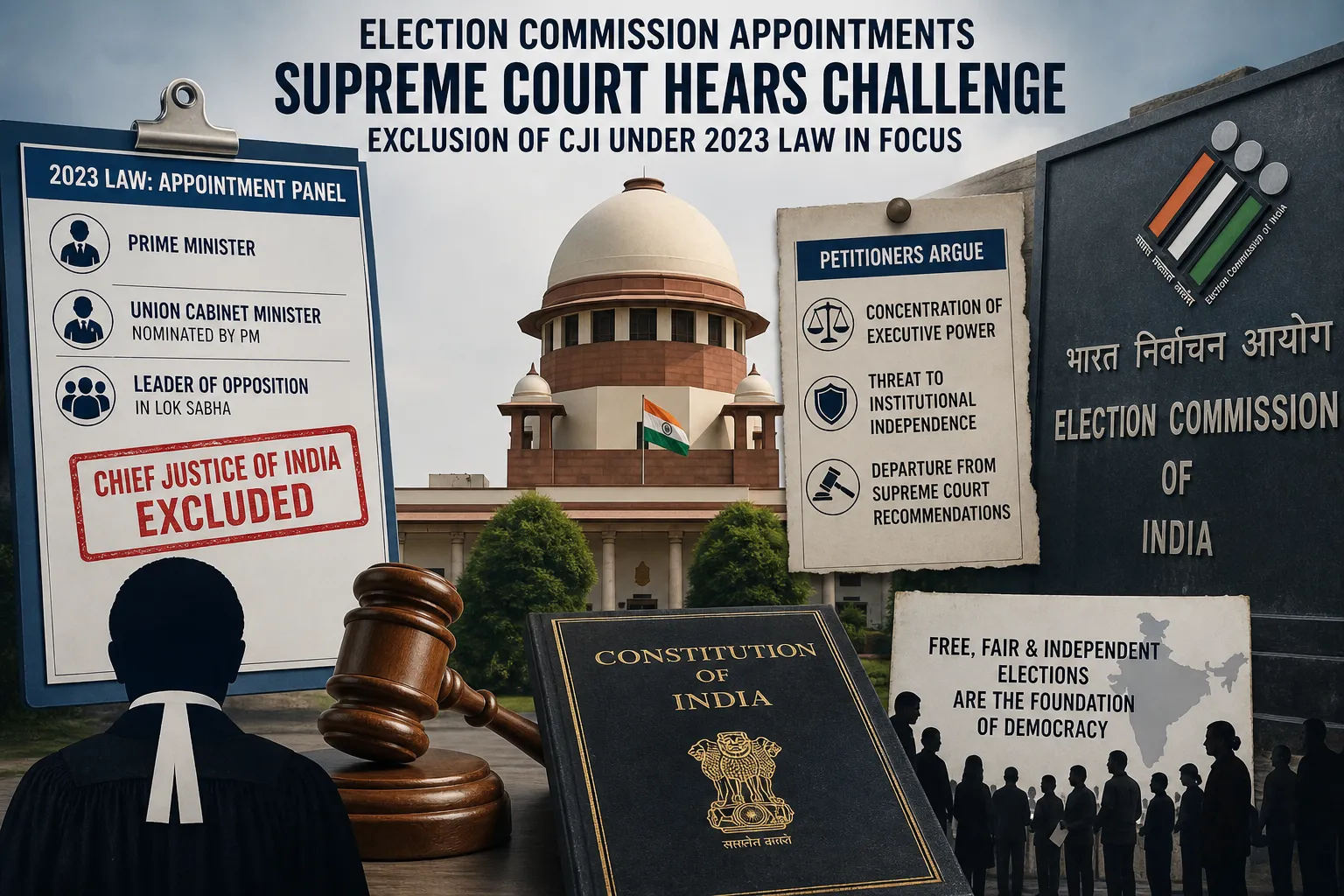
Under the new law, the appointment panel consists of:
-
The Prime Minister
-
A Union Cabinet Minister nominated by the Prime Minister
-
The Leader of the Opposition in the Lok Sabha
Notably absent from this panel is the Chief Justice of India.
This change marked a departure from an earlier framework suggested by the Supreme Court itself in a landmark 2023 judgment. At that time, the court had directed that appointments should be made by a committee comprising the Prime Minister, the Leader of Opposition, and the Chief Justice of India until Parliament enacted a formal law on the matter.
The inclusion of the CJI was seen as an attempt to create institutional balance and safeguard the independence of the Election Commission.
Why the Exclusion of the CJI Is Being Challenged
Petitioners challenging the law argue that removing the Chief Justice from the panel weakens the neutrality and independence of the appointment process.
Their concerns center around several key issues:
1. Concentration of Executive Power
Critics argue that the new structure gives the executive branch greater influence over appointments. Since two of the three members on the panel effectively represent the government, opponents believe this may compromise the perception of neutrality.
2. Threat to Institutional Independence
The Election Commission is expected to function independently, particularly during elections involving ruling governments. Petitioners contend that the appointment process must therefore include safeguards against political influence.
3. Departure from Judicial Recommendations
The Supreme Court’s earlier judgment had emphasized the importance of including the Chief Justice as a neutral constitutional authority. The exclusion is seen by challengers as inconsistent with the spirit of that ruling.
The petitioners maintain that institutional credibility depends not only on actual independence but also on public confidence in the fairness of the process.
Supreme Court Signals Urgency
During the recent proceedings, the Supreme Court refused the Centre’s request to delay the hearing, indicating that the matter carries significant constitutional importance.
The bench reportedly emphasized that questions concerning the Election Commission’s independence require priority consideration. This observation reflects the judiciary’s recognition of the ECI’s critical role in maintaining democratic integrity.
The court’s stance also suggests an awareness of the broader public interest involved. The outcome of the case could shape the future functioning of one of India’s most important constitutional bodies.
The Election Commission’s Crucial Role
The Election Commission of India is responsible for overseeing national and state elections, ensuring compliance with electoral laws, and maintaining fairness in the democratic process.
Its responsibilities include:
-
Conducting Lok Sabha and state assembly elections
-
Monitoring political parties and campaign conduct
-
Enforcing the Model Code of Conduct
-
Managing voter registration and electoral rolls
Given these powers, the credibility of the institution is essential for democratic stability.
Any perception that the Commission may be influenced by political considerations can undermine public trust in the electoral process.
The Debate Over Institutional Independence
The case has reignited broader discussions about the independence of constitutional institutions in India.
Supporters of the government’s position argue that Parliament has the authority to legislate on appointment mechanisms and that elected representatives should play the primary role in such decisions.
They also contend that the inclusion of the Leader of Opposition provides an adequate level of balance within the committee.
However, critics argue that institutions responsible for safeguarding democracy require stronger insulation from executive influence. They believe the presence of the Chief Justice would provide an additional layer of impartiality.
This debate reflects a larger constitutional question: how should democratic systems balance accountability with institutional autonomy?
Judicial Oversight and Constitutional Balance
The Supreme Court’s involvement highlights the judiciary’s role as a constitutional guardian. Courts often intervene in matters where institutional checks and balances are perceived to be at risk.
In its earlier judgment on election commissioner appointments, the Supreme Court had observed that the independence of the Election Commission is integral to preserving democracy.
The current challenge therefore goes beyond procedural concerns. It touches upon fundamental constitutional principles, including:
-
Separation of powers
-
Institutional accountability
-
Protection of democratic processes
The court’s eventual ruling could have long-term implications for how constitutional appointments are structured in India.
Public Trust and Democratic Legitimacy
One of the central issues in this debate is public trust. Democracies depend not only on fair systems but also on citizens’ confidence in those systems.
The Election Commission’s authority is largely moral and institutional. Its effectiveness relies on public acceptance of its neutrality and decisions.
Even the perception of bias can weaken democratic legitimacy. This is why appointment processes for constitutional bodies are often designed to include multiple stakeholders and checks against concentrated power.
The current legal challenge reflects concerns that such balance may be weakened under the new framework.
Global Perspectives on Election Oversight
Globally, democracies adopt different models for appointing election officials. Some rely heavily on legislative oversight, while others involve judicial or independent constitutional authorities.
In many countries, efforts are made to ensure that election bodies are insulated from direct political control. This often includes bipartisan appointment systems, fixed terms, or independent commissions.
India’s debate therefore mirrors broader international discussions about how democracies can maintain trust in electoral institutions amid increasing political polarization.
Political and Constitutional Sensitivity
The timing of the case also adds to its significance. Electoral processes are always politically sensitive, and any legal dispute involving the Election Commission naturally attracts close scrutiny.
At the same time, the judiciary must balance constitutional interpretation with respect for legislative authority.
The case therefore presents a complex intersection of law, politics, and democratic governance.
Regardless of the outcome, the proceedings are likely to influence future discussions on institutional reforms and constitutional accountability.
Looking Ahead
The Supreme Court’s decision to prioritize the hearing suggests that the issue will remain at the forefront of constitutional debate in the coming months.
Several possible outcomes could emerge:
-
The court may uphold the law as constitutionally valid
-
It may recommend modifications to the selection process
-
It could reaffirm the need for broader institutional representation in appointments
Whatever the verdict, the case will likely shape the future discourse around electoral reforms and constitutional governance in India.
Conclusion
The Supreme Court’s refusal to defer hearings on the exclusion of the Chief Justice of India from the election commissioner appointment panel marks an important moment in India’s constitutional and democratic journey.
At stake is not merely the composition of a committee, but the broader principle of institutional independence and public trust in the electoral system.
The case highlights the delicate balance between executive authority, judicial oversight, and democratic accountability. It also underscores the importance of ensuring that institutions tasked with protecting democracy remain credible, impartial, and free from undue influence.
As the hearings continue, the outcome will be closely watched not only for its legal implications but also for what it reveals about the evolving relationship between India’s constitutional institutions and the democratic values they are meant to uphold.
feedopr.com feedopr.com feedopr.com feedopr.com feedopr.com feedopr.com feedopr.com feedopr.com feedopr.com feedopr.com feedopr.com feedopr.com feedopr.com feedopr.com feedopr.com feedopr.com feedopr.com feedopr.com feedopr.com feedopr.com feedopr.com feedopr.com feedopr.com feedopr.com feedopr.com feedopr.com feedopr.com feedopr.com feedopr.com feedopr.com feedopr.com feedopr.com feedopr.com feedopr.com feedopr.com feedopr.com feedopr.com feedopr.com feedopr.com feedopr.com feedopr.com feedopr.com feedopr.com feedopr.com feedopr.com feedopr.com feedopr.com feedopr.com feedopr.com feedopr.com feedopr.com feedopr.com feedopr.com feedopr.com feedopr.com feedopr.com feedopr.com feedopr.com feedopr.com feedopr.com feedopr.com feedopr.com feedopr.com feedopr.com feedopr.com feedopr.com feedopr.com feedopr.com feedopr.com feedopr.com feedopr.com feedopr.com feedopr.com feedopr.com feedopr.com feedopr.com feedopr.com feedopr.com feedopr.com feedopr.com feedopr.com feedopr.com feedopr.com feedopr.com feedopr.com feedopr.com feedopr.com feedopr.com feedopr.com feedopr.com feedopr.com feedopr.com feedopr.com feedopr.com feedopr.com feedopr.com feedopr.com feedopr.com feedopr.com feedopr.com feedopr.com feedopr.com feedopr.com feedopr.com feedopr.com feedopr.com feedopr.com feedopr.com feedopr.com feedopr.com feedopr.com feedopr.com feedopr.com feedopr.com feedopr.com feedopr.com feedopr.com feedopr.com feedopr.com feedopr.com feedopr.com feedopr.com feedopr.com feedopr.com feedopr.com feedopr.com feedopr.com feedopr.com feedopr.com feedopr.com feedopr.com feedopr.com feedopr.com feedopr.com feedopr.com feedopr.com feedopr.com feedopr.com feedopr.com feedopr.com feedopr.com feedopr.com feedopr.com feedopr.com feedopr.com feedopr.com feedopr.com feedopr.com feedopr.com feedopr.com feedopr.com feedopr.com feedopr.com feedopr.com feedopr.com feedopr.com feedopr.com feedopr.com feedopr.com feedopr.com feedopr.com feedopr.com feedopr.com feedopr.com feedopr.com feedopr.com feedopr.com
